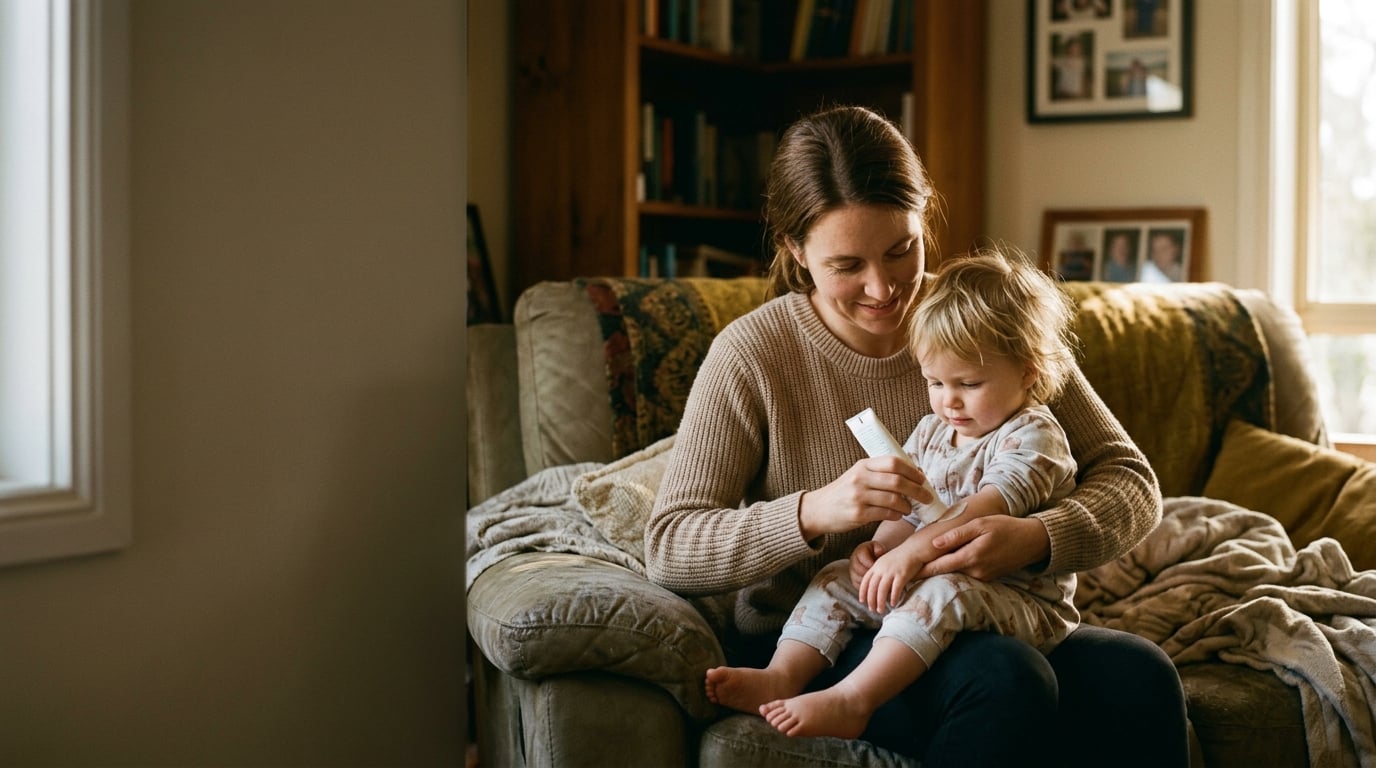
Childhood Eczema & Baby Skin: A Reassuring Approach
Watching your child scratch and struggle can be heartbreaking. This hub is written for parents — without blame, without fear — to help you understand what may be contributing and what questions are worth asking.
What Is Childhood Skin?
Childhood eczema is one of the most common skin conditions in babies and young children. It typically appears as dry, itchy, inflamed patches — often on the cheeks, scalp, and the folds of the arms and legs — and can flare and settle repeatedly.
For parents, it is often exhausting and emotional. Broken sleep, constant scratching, and the worry of not knowing what is causing it can weigh heavily. We want to say something clearly: this is not your fault. Parents frequently arrive carrying guilt, and part of our role is to replace that with reassurance and practical understanding.
Children’s skin tells a story that begins remarkably early. That is why our investigation with families gently explores the whole journey — from pregnancy and birth through to today.
You Are Not Alone
Families who come to us often describe the same challenges. If this sounds like your household, you are far from alone.
Night-time scratching
A child who scratches in their sleep, waking themselves — and everyone else.
Broken family sleep
Exhausted parents and siblings after months of interrupted nights.
Sore, weeping skin
Cracked or weeping patches that are uncomfortable and prone to infection.
Behaviour and mood
Irritability and difficulty concentrating that come with poor sleep and constant itch.
Parental guilt
The heavy, unnecessary feeling that you have done something wrong.
School and social life
Worry about how visible skin affects a child’s confidence with friends.
Respecting Established Care
Conventional paediatric and medical care is important and should always continue. Common management includes:
- Regular emollients and moisturisers to support the skin barrier.
- Topical corticosteroids during flares, as prescribed.
- Bathing and skincare routines.
- Allergy assessment where indicated.
- Review with your GP, paediatrician or dermatologist.
We work alongside your child’s medical team, never in place of them. Our contribution is a gentle, investigative conversation about the whole journey that led to your child’s skin.
Looking Beyond The Surface
With children, our investigation gently follows the developmental timeline. We explore the areas that so often hold clues:
Pregnancy & Birth
The pregnancy, birth experience and any early complications that may be relevant.
Breastfeeding & Formula
Early feeding history and how it may relate to your child’s skin.
Early Antibiotics
Antibiotic use in the early months and years, a pattern we frequently explore.
Food Introduction
How and when foods were introduced, and any responses observed.
Digestive Health
Tummy symptoms, bowel patterns and comfort after eating.
Sleep & Behaviour
How sleep and mood have been affected, for the child and the family.
Family History
Patterns of eczema, allergy or asthma across the family.
Environment
The everyday environment at home and its possible role.
Where food appears to be part of the picture, we use a non-invasive computer controlled food intolerance screening system to help identify and eliminate likely trigger foods quickly — always interpreted within the full context of your history. See how we investigate.
The Conversation That Reveals The Story
These are examples of the kinds of questions we explore together. They gently demonstrate how a consultation actually works.
When did your child’s eczema first appear?
How was the pregnancy and birth?
Was your child breastfed, formula-fed, or both?
Were antibiotics used in the early months or years?
How were foods introduced, and did you notice any reactions?
How is your child’s digestion and sleep?
Is there a family history of eczema, allergy or asthma?
Insights From Three Decades
These are observations developed through more than 65,000+ consultations. They are shared as clinical experience — never as diagnosis or certainty.
We frequently observe childhood eczema following early antibiotic use.
Many parents report flares that relate to certain foods, though this is individual.
In our clinical experience, digestive comfort and skin comfort often go together.
We often see a family history of eczema, asthma or hay fever.
Many families find that understanding the timeline brings real relief.
One Possible Contributor — Never The Whole Story
Food is explored gently and individually as one possible contributor — never as blame, and never with unnecessary restriction that could affect a growing child.
- How and when foods were introduced during infancy.
- Food additives and processed foods that some children appear sensitive to.
- Possible food intolerances explored carefully and safely.
- A personalised, nutrition-aware approach that protects healthy growth.
Childhood Skin — Your Questions Answered
Itching often feels most intense in the evening and overnight, when the skin is warm and there are fewer distractions. Night scratching and broken sleep are among the most common concerns parents share with us.
No. Please let go of that worry. Eczema arises from many interacting factors — genetic tendency, early events, environment and more. Our role is to help you understand it, not to assign blame.
It may be one contributor for some children, but responses are highly individual and we never recommend unnecessary restriction. Any dietary exploration is done carefully to protect healthy growth.
We frequently explore early antibiotic history with families, as it is a pattern we observe often. This is part of building the full picture, not a criticism of necessary medical care.
Some children do improve with age, but every child is different. We avoid absolute predictions and focus instead on understanding and supporting your child’s individual situation.
No. Please continue your child’s medical care and discuss any changes with your GP, paediatrician or dermatologist. Our work sits alongside that care.
Yes. We regularly work with families of babies and young children, always gently and always in coordination with your child’s medical team.
Related Reading



Ready To Understand Your Story?
Book your consultation today and begin a thorough, unhurried investigation into what may be contributing to your skin.
This page is educational and does not constitute medical advice or diagnosis. Always maintain the care of your GP and dermatologist, and seek immediate medical attention for severe or rapidly worsening symptoms.